2.04.2012

Sand County Saturdays


See how the squirrel is all hunched in one position and eyeing me cautiously?  That's how I've felt for the last three days.  Except I've been on a couch or in the bed, and the thing I've been eyeing so warily is the pain that seems to be out to get me.  I'm pretty sure all I've got is some sort of infection caused by the MASSIVE amount of drainage that has set up camp in my throat, and I do feel much better today - thankyouverymuch -  so perhaps it will head out by tomorrow.  I'm playing it safe and resting a great deal and managing to get a lot of reading done as well.  Most of it has been of the magazines that have been sitting around for 2 weeks variety, but I have also spent some time with Mr. Leopold in Sand County and am happy to report he still has things to say that thrill my soul.  I made it to December just after filling my bird feeders, so as he explained about the habits of the chickadee, I was listening to the insistent chirp of the first cardinal who had discovered my action.  I never can tell for sure if he is announcing it to loved ones or crowing proudly at being the one to find it first.

Here are some of the things I loved in Part One: A Sand County Almanac.

From February:
There are two spiritual dangers in not owning a farm.  One is the danger of supposing that breakfast comes from the grocery, and the other that heat comes from the furnace.  To avoid the first danger, one should plant a garden, preferably where there is no grocer to confuse the issue.  To avoid the second, he should lay a split of good oak on the andirons, preferably where there is no furnace, and let it warm his shins while a February blizzard tosses the trees outside. (6)
April:
The drama of the sky dance is enacted nightly on hundreds of farms, the owners of which sigh for entertainment, but harbor the illusion that it is to be sought in theaters.  They live on the land, but not by the land. (34)
July:
The erasure of human subspecies is largely painless - to us - if we know little enough about it.  A dead Chinaman is of little import to us whose awareness of things Chinese is bounded by the occasional dish of chow mein.  We grieve only for what we know. (48)
September:
...things hoped for have a higher value than things assured. (54)
October:
And when a flock of bluebills, pitching pondward, tears the dark silk of heaven in one long rending nose-dive, you catch your breath at the sound, but there is nothing to see except stars. (61)
November:
 A conservationist is one who is humbly aware that with each stroke he is writing his signature on the face of his land. (68)
December:
This is especially likely to happen on some gloomy evening when the snow has buried all irrelevant detail, and the hush of elemental sadness lies heavy upon every living thing. (87)
I hope these snippets inspire you to pick up a copy of A Sand County Almanac.  And if your weekend allows it (and you aren't confined to the couch as I am), consider taking a walk in the woods somewhere.

2.03.2012

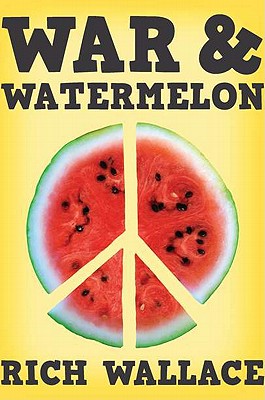
War & Watermelon by Rich Wallace


What is it about being a white, middle (or upper-middle) class kid that means you have to doodle peace signs on everything?  My daughter is 7 and has already learned how to make these little symbols and adds them to many of her drawings.  My 5-year-old son has even started making them, all lopsided though they may be.  I certainly did it; I have the class notes to prove it (Yep.  I've kept my notes.  That's just how nerdy I am.)  Casting our minds back to the 60s and 70s - BEFORE WE WERE EVEN BORN - seems like just part of growing up, like seeking independence in your life means you have to look to those godfathers of rebellion: the hippies.  But for all the ridiculous romanticizing of what was honestly not that great a time period, what with segregation, Vietnam, and all the great leaders getting shot, it was still an important period in history and is worthy of writing about.

In War & Watermelon, Rich Wallace has done a little bit of the romanticizing part and a little bit of the capturing history part.  He tells the story of 13-year-old Brody in the fabled summer of '69.  Brody plays football, hangs out with his buddy Tony, listens to the radio, and worries about his brother, Ryan, who will be 18 soon and will likely be drafted and sent to Vietnam.

This book was recommended (and gifted) to me by Serena at Savvy Verse & Wit (see her review here) as a great book for that hard-to-recommend-for 10-12 year old boy set.  It does a good job of capturing the kind of real-life angst, not melodrama, that middle school boys might honestly experience.  The sports play-by-plays were especially good, I thought, because even my grown husband still feels compelled to provide me with way more detail to my simple question: "How did the game go?"  Recounting plays resonates with a lot of guys, so this relatively insignificant part of the plot goes a long way toward establishing credibility to those young readers.

Too much of the rest of it seems like it might lose the interest of the average teenage boy or even his mother, especially the Top 40 song references and the poems that were scattered in between chapters randomly.  As coincidence would have it, I was sick yesterday and watched the first episode of The Wonder Years on Netflix.  Same time period, same situations for the characters: Kevin and Paul are starting Junior High; Winnie's older brother gets drafted.  They don't make it to Woodstock, but the similarities are otherwise striking.  Equally striking, however, is how much more emotional punch a single 24-minute episode of The Wonder Years can pack as opposed to this novel.

The thing is, this book might be fantastic to a boy reader and it might not.  It's not terribly edgy; in fact, it plays most things downright safe.  There's not a whole lot of action, at least not the kind many middle-school boys are accustomed to in tv and movies.  It seems simultaneously too young (all the playing it safe) and too old for them (It is Woodstock, after all.  Nudity and pot smoking required).  Since I am not a teen boy and haven't worked with them in awhile, I just don't know how to gauge their likely response.  So, I'm going to gift my signed copy to the Middle School library at the all-boys school where my husband works, and I'm going to ask the librarian to give me some feedback on whether or not guys actually like it.

As for what boys this age do like (and girls and all the other ages), The Center for Teaching and Learning keeps a regularly updated list of books recommended by kids on their website.  The kids there (under the expert leadership of one of my heroes, Nancie Atwell) take reading pretty seriously, so you can trust that the stuff on the list has been genuinely enjoyed.

2.01.2012

Poetry: Read More/Blog More


For awhile now, I've been a fan of  Regular Rumination and of Lu, so it should come as no surprise that I want to tag along with her great idea to challenge us all to read more poetry and to post more about it.  Poetry is a semi-frequent part of my wordyevidence equation as I write it and read it, but I like the formality of this idea.  Making sure I get in one post a month and knowing that there are several other folks across the interweb doing the same will certainly raise the profile of poetry for all of us.  Plus, I like the pretty blue button.

To respond to this challenge, I pulled from the TBR shelves a little volume I picked up at the last Conference on Southern Literature.  It is called Kingdom of the Instant and comes from contemporary poet Rodney Jones.  This book (published in 2002) is not his most recent or most acclaimed collection, but it is the one I chose.  I don't even remember why, unless it was his unaffected, quiet tone resonating from the stage.  Wanna' hear for yourself?  Watch this little video from the Griffin Poetry Prize (for which his book Salvation Blues was shortlisted).

Well, whatever the initial reason, the result was notsomuch.  I hate to start off this cool event (which I am, of course, late to) with a less than glowing review, but this collection just did not sing my favorite tunes.  There are jewel-bright moments, undoubtedly, (like the line "Days flash-seal with a pop like canning jars"), but the overall effect of most of the poems and of the collection as a whole was unsatisfying.  Jones constructs a type of poem that probably annoys Ted Kooser considerably.  It is intentionally abstract and is written in a form that the poem neither demands nor supports.  In his The Poetry Home Repair Manual, Kooser writes
Many contemporary poets choose to use, say, three-line stanzas, possibly because it makes the poem look more orderly and suggests a relationship to music.  After all, we do talk about poems as "lyric."  Whatever their reason, unless the stanzas make some sense as blocks of speech, like paragraphs in prose, they can call attention to themselves. ... The reader stops to think, why on earth is this poem chopped up like this?  Is it just to make it look like a poem? (68)
Jones does this very thing in many of his poems, and while I am not at all against a narrative-driven poem or a visually-experimental poem, I have to agree with Kooser regarding the affected feeling of this choice.  And though I don't always agree with Kooser about a poem's need to be accessible, Jones is really hit-or-miss in the "does this line make any natural sense" category.  To read his poems is to be reminded of the masterful nonsense of Eliot, so that could be considered a good thing.  However, like Eliot, Jones sometimes made me pause and wonder: was that really good or really crazy?  Too often, I found myself slipping through his poems, enjoying the rhythm and sound of the lines, but not really trying to take any meaning from them.  Here's an example from the opening lines of the opening poem, "Keeping Time":
To be in there with it, tock to its tick, mud
to its chink, oh, but running, unthinking,
alive, lurid, unprepossessing, liquid,
mercurial, lucky scalpel, leap,
love cry, music sticking from the violin.
It has a cool, jazzy sound, but making sense of it takes more energy than I was willing to give, even on a second reading.  Conversely, I found these two images to be unbelievably rich:
And that was Grandma Owen,
a vine, as I remember her in her dotage,
putting out the brown flower
of one hand. (p. 15)
until, as he always did,
Miles Winton's incorrigible mongrel
spurted up from the ditchbank
like a flame turned inside out,
sleek black to the bone with rage (p. 45)
There were other such moments, and I wish I could sing this collection's praises.  I wish (for your sake, but more for mine) that it had raised the hackles of my very soul, but this time it just didn't happen that way.  Just like with novels, short stories, essays, songs, and television shows, some will strike us just right, and others will falter.   It won't keep me from reading poetry, though, so I'm glad for this ongoing chance to explore new voices and to bring more poetry to light in this space.